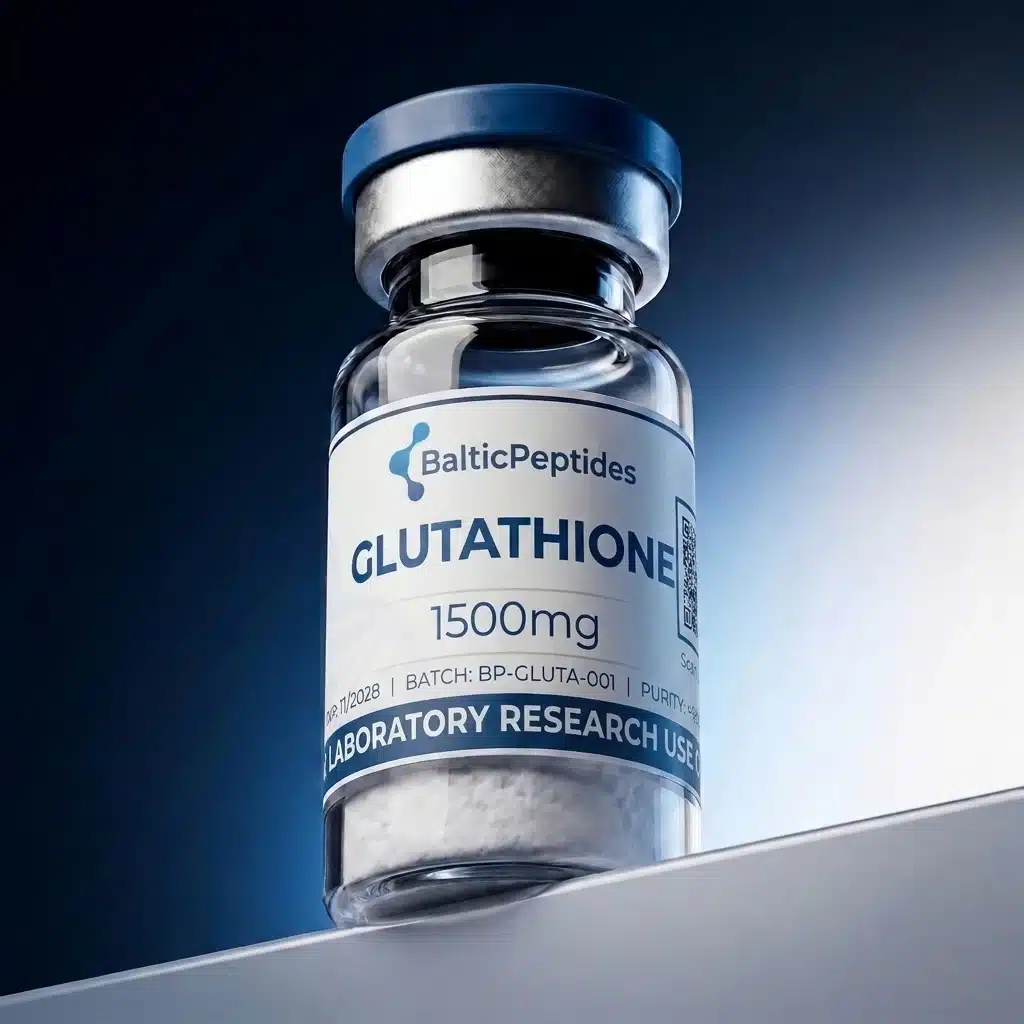
Glutathione 1500mg
Original price was: 59,99 €.47,99 €Current price is: 47,99 €.
Frequently bought together
Glutathione Europe Reduced L-Glutathione (GSH) · 1500mg per Vial · ≥99% HPLC
Baltic Peptides supplies Glutathione in Europe as research-grade reduced
L-Glutathione (GSH), lyophilised in 1500mg vials at ≥99% analytical purity and verified
by independent third-party HPLC. Every order of Glutathione EU stock ships from our
fulfilment centre in Lithuania, so researchers across the European Union receive their
compound without non-EU customs delays.
Glutathione is a tripeptide of L-glutamate, L-cysteine and glycine, joined by an unusual
γ-peptide bond. It is the most abundant intracellular low-molecular-weight thiol in
mammalian cells and the principal endogenous antioxidant and redox-buffering system. It is
studied in preclinical and cell-based research on oxidative stress, hepatic phase II
detoxification, immune-cell redox signalling and melanin synthesis.
This compound is supplied exclusively for in vitro and preclinical research
by qualified investigators and research institutions.
Third-Party Verified · Batch COA · EU Dispatch
Key Features
-
Purity — ≥99% by HPLC analysis
-
Fill — 1500mg reduced L-Glutathione per vial
-
Form — Lyophilised powder, single-use vials
-
Storage (long-term) — −20 °C, desiccated, protected from light
-
Storage (short-term) — 2–8 °C, up to 4 weeks
-
Solubility — Sterile or bacteriostatic water (solution is acidic)
-
Classification — Research Use Only (RUO)
-
Dispatch — Ships from Lithuania across the EU
Buy Glutathione in Europe
Researchers who want to buy Glutathione in Europe usually face two problems:
material shipped from outside the EU that is held at customs, and purity claims that cannot be
checked. Baltic Peptides addresses both. Our Glutathione EU stock is held and dispatched within
the European Union, and batch test results are published on our
COA page so you can review the data before you order.
Scientific Overview of Glutathione
Compound Background
Glutathione (γ-L-glutamyl-L-cysteinyl-glycine) is synthesised in virtually all mammalian
cells by a two-step, ATP-dependent pathway. Glutamate-cysteine ligase (GCL) first joins
glutamate and cysteine through the atypical γ-peptide bond; glutathione synthetase then
adds glycine. The γ-linkage resists most intracellular peptidases, which helps explain
glutathione’s high steady-state concentrations (low millimolar in hepatocytes). The
cysteine thiol (-SH) is the functional centre: it donates electrons in redox reactions,
scavenges reactive oxygen species and acts as a nucleophile in phase II conjugation.
Acid 1
›
2 (Thiol)
›
3
The Glutathione Redox Cycle
Cells hold glutathione in a dynamic balance between its reduced (GSH) and oxidised
(GSSG, glutathione disulfide) forms. When GSH neutralises a reactive species, two molecules
form one GSSG; NADPH-dependent glutathione reductase then regenerates GSH. The GSH:GSSG
ratio is a widely used preclinical marker of oxidative stress, with a falling ratio
indicating a more oxidising intracellular environment.
Oxidative Stress Buffering and Detoxification
Glutathione’s research relevance rests on three biochemical roles:
Direct Antioxidant Action
The cysteine thiol directly scavenges free radicals and reactive oxygen and nitrogen species, buffering redox state in the cytosol, mitochondria and nucleus.
Enzymatic Antioxidant Systems
Glutathione peroxidases use GSH to reduce hydrogen peroxide and lipid peroxides, a key defence against oxidative lipid damage.
Phase II Detoxification
Glutathione S-transferases conjugate GSH to electrophilic xenobiotics and metabolites, a pathway central to hepatotoxicity research.
Primary Research Domains
Oxidative Stress & Redox Biology
Hepatic Detoxification
Immune Redox Signalling
Melanogenesis Research
mammalian cells. Exogenous GSH has limited direct cell permeability in many cell types because
cell-surface γ-glutamyltranspeptidase (GGT) hydrolyses it, which can affect the design and
interpretation of supplementation studies.
literature on endogenous glutathione eu biology. They are not therapeutic claims, and this product
is not intended for clinical or cosmetic use.
Glutathione Technical Specifications
| Parameter | Specification |
|---|---|
| Compound Name | Glutathione (Reduced; L-Glutathione; GSH) |
| Compound Class | Endogenous tripeptide; cellular antioxidant; redox cofactor |
| Sequence | γ-L-Glutamyl-L-Cysteinyl-Glycine |
| Molecular Formula | C10H17N3O6S |
| Molecular Weight | 307.32 g/mol |
| CAS Number | 70-18-8 |
| Purity | ≥99% (HPLC, per batch) |
| Vial Fill | 1500mg reduced L-Glutathione |
| Form | Lyophilised powder |
| Appearance | White to off-white crystalline powder |
| Solubility | Freely soluble in sterile and bacteriostatic water; solution is acidic |
| Long-Term Storage | −20 °C, desiccated, protected from light |
| Short-Term Storage | 2–8 °C, sealed vial, up to 4 weeks |
| Reconstituted Stability | Up to 28 days at 2–8 °C; protect from light and air |
| Dispatch | Lithuania, EU · tracked |
| Classification | Research Use Only (RUO) |
Lab Testing & Quality Assurance
The cysteine thiol that makes glutathione eu useful also makes it prone to oxidation, which
converts reduced GSH into GSSG. Each batch of our Glutathione EU stock is therefore analysed by
independent third-party laboratories before release.
HPLC Purity Analysis
Reverse-phase HPLC confirms ≥99% purity for each production batch.
Identity Confirmation
Identity is confirmed against a reduced glutathione reference (307.32 g/mol).
Certificate of Analysis
Batch-specific COAs with lot number and test date are published on our COA page.
Third-Party Verification
All analytical data comes from independent external laboratories, not in-house testing.
Storage & Handling
The key handling consideration for reduced glutathione is protecting the thiol group from
oxidation. Air, heat, light and trace metal ions all convert GSH to GSSG over time.
Lyophilised (Unopened)
−20 °C, desiccated, protected from light. Minimise air exposure when opened.
Short-Term (Unopened)
2–8 °C for up to 4 weeks, sealed and protected from humidity and light.
Reconstituted Solution
2–8 °C, up to 28 days, protected from light. Discard if discoloured.
Reconstitution Notes
Add diluent slowly along the vial wall and swirl gently; do not vortex. Minimise headspace air.
⚠️ Research Use Only — Important Notice
All Baltic Peptides products (including glutathione europe) are supplied exclusively for in vitro research, preclinical
investigation and laboratory study by qualified professionals in appropriate research
environments.
This research-grade reduced L-Glutathione is not approved for human or veterinary
therapeutic, clinical or cosmetic use by the EMA, FDA, MHRA or any other medicines
regulator. It is not intended for self-administration, clinical application, cosmetic injection
or any use outside controlled scientific research.
By purchasing Glutathione Europe, the buyer confirms they are a qualified researcher and acknowledges the
research-use-only classification of this compound.
Glutathione Europe: Frequently Asked Questions
Where can I buy glutathione Europe?
You can buy research-grade reduced L-Glutathione (1500mg, ≥99% HPLC) directly from Baltic
Peptides. Our Glutathione Europe stock is dispatched from Lithuania inside the EU, with tracked
delivery and batch COAs published on our COA page. It is sold strictly for
research use.
Do you ship glutathione within the EU?
Yes. Every Glutathione EU order ships from our Lithuanian fulfilment centre, which avoids non-EU
customs delays for most member states. Orders placed before 16:00 (GMT+3) on business days are
dispatched the same day, and delivery is free over €150. Details are on our
shipping page.
What is glutathione used for in scientific research?
Reduced glutathione (GSH) is studied as the principal endogenous antioxidant and redox cofactor. Common research applications include:
- Oxidative stress biology: GSH:GSSG ratio, glutathione peroxidase and reductase assays
- Hepatic detoxification: phase II conjugation and drug-induced liver injury models
- Mitochondrial redox biology and oxidative damage models
- Immune cell redox status, cytokine production and NF-κB signalling
- Ferroptosis research: glutathione depletion and lipid peroxidation
- Melanogenesis: tyrosinase pathway and eumelanin/pheomelanin balance
What is the difference between reduced (GSH) and oxidised (GSSG) glutathione?
Reduced glutathione (GSH) has a free thiol (-SH) on its cysteine residue, allowing it to donate
electrons and neutralise reactive species. Two GSH molecules then join through a disulfide bond to
form oxidised glutathione (GSSG), which lacks free thiol reactivity. Healthy cells keep the
GSH:GSSG ratio high (often above 100:1) through glutathione europe reductase. Baltic Peptides supplies
the reduced (GSH) form.
Why is cell permeability a consideration in glutathione research?
Intact GSH does not freely cross the plasma membrane of many cell types. Cell-surface
γ-glutamyltranspeptidase (GGT) breaks extracellular GSH down into precursors that cells take
up and use to resynthesise glutathione europe. Researchers often include GGT measurements or comparators
such as N-acetylcysteine or glutathione ethyl ester when intracellular delivery is the variable
under study.
How should reconstituted glutathione eu be stored?
Store reconstituted solutions at 2–8 °C, protected from light, and use within 28
days. Minimise headspace air and repeated septum punctures, and use high-purity diluents, since trace
metals catalyse thiol oxidation. Keep unopened lyophilised vials at −20 °C.
Is a Certificate of Analysis available for Glutathione?
Yes. Each production lot is independently tested, and batch COAs with HPLC purity, lot number
and test date are published on our COA page.
Related products
-
Estimated delivery: Nov 24, 2026 - Nov 25, 2026
Selank 10mg
Price range: 27,99 € through 31,99 € Select options This product has multiple variants. The options may be chosen on the product page -
Estimated delivery: Nov 24, 2026 - Nov 25, 2026
KLOW 80mg (KPV + BPC-157 + TB-500 + GHK-Cu)
Original price was: 89,99 €.71,99 €Current price is: 71,99 €. Add to cart -
Estimated delivery: Nov 24, 2026 - Nov 25, 2026