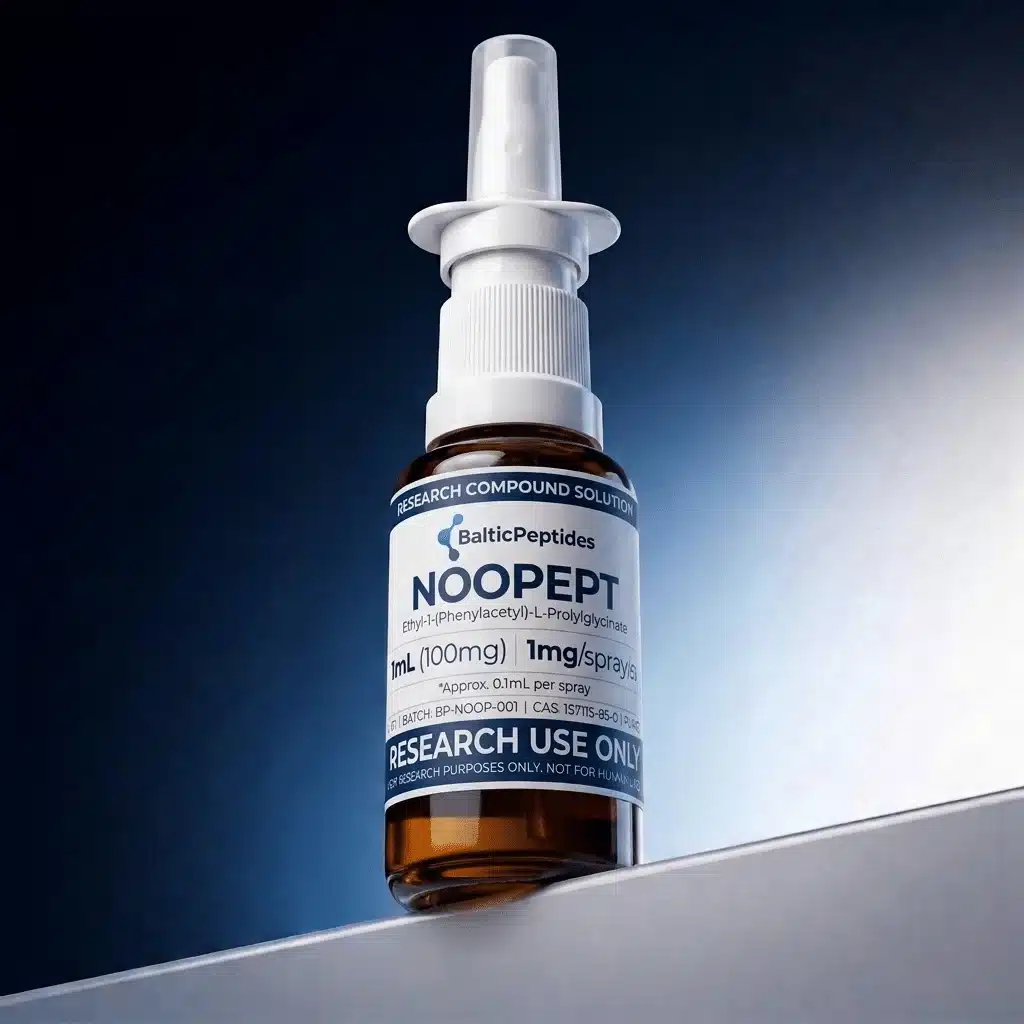
Noopept (10ml)
Original price was: 34,99 €.27,99 €Current price is: 27,99 €.
Noopept Europe GVS-111 · N-Phenylacetyl-L-Prolylglycine Ethyl Ester
Noopept Europe is supplied by Baltic Peptides as a crystalline research compound at ≥99% analytical purity, verified per batch by independent HPLC and mass spectrometry. Noopept (GVS-111, omberacetam) is N-phenylacetyl-L-prolylglycine ethyl ester — a small, dipeptide-derived molecule designed in Moscow as a peptide analogue of the racetam nootropics.
In the body, Noopept is metabolised to cyclo-L-prolylglycine (cycloprolylglycine, CPG), a cyclic dipeptide that also occurs naturally in the brain. Rodent studies report increased hippocampal BDNF and NGF expression, AMPA-receptor-related activity attributed to CPG, and protection in oxidative-stress and amyloid models, which has made Noopept a reference compound in cognition and neuroprotection research.
Supplied exclusively for in vitro and preclinical research by qualified investigators and licensed research institutions.
Third-Party Verified · COA Available · EU Dispatch
Analytical Purity
HPLC · Mass Spec Verified
Key Features
Researchers choosing Noopept Europe from Baltic Peptides receive a ≥99% HPLC-verified, independently tested nootropic research compound dispatched from within the EU.
-
Purity — ≥99% by HPLC analysis
-
Form — Fine crystalline powder
-
Storage — Cool, dry and sealed; protected from light
-
Solubility — Ethanol or DMSO for stock solutions; moderate solubility in water
-
Metabolite — Cyclo-L-prolylglycine (an endogenous cyclic dipeptide)
-
Classification — Research Use Only (RUO)
-
Testing — Independent third-party batch verification
-
Documentation — Certificate of Analysis per batch
Scientific Overview — Noopept Europe
Compound Background
Origin and Design
Noopept was developed in the 1990s by T. A. Gudasheva and colleagues at the Zakusov Institute of Pharmacology in Moscow. The team built a dipeptide (Pro-Gly) version of the piracetam scaffold, adding a phenylacetyl group to the N-terminus and an ethyl ester to the C-terminus to improve metabolic stability. It is registered as a medicine in Russia but is not approved by the EMA or FDA.
Noopept is best understood as a prodrug. It is metabolised to cyclo-L-prolylglycine, a cyclic dipeptide that is also produced naturally in the brain and has been reported to modulate AMPA receptors and BDNF signalling. Many of Noopept’s reported effects in rodents — on memory tasks, BDNF and NGF expression, and neuroprotection — are attributed at least partly to this metabolite.
Noopept vs Piracetam
| Parameter | Noopept | Piracetam |
|---|---|---|
| Chemical class | N-acyl dipeptide ethyl ester | Pyrrolidone (racetam) |
| Molecular weight | 318.4 g/mol | 142.2 g/mol |
| Active metabolite | Cyclo-L-prolylglycine | None (acts as parent) |
| Relative potency in rodent models | Much higher (active at far lower concentrations) | Reference |
| Regulatory status | Registered in Russia | Approved in several EU countries |
Primary Research Domains
Signalling Pathway — Research Context
Noopept (GVS-111)
Ester Hydrolysis → Cyclo-L-prolylglycine
AMPA Receptor Modulation
↑ BDNF / NGF Expression
Memory & Neuroprotection Endpoints
Technical Specifications — Noopept Europe
| Parameter | Specification |
|---|---|
| Compound Name | Noopept (GVS-111; omberacetam) |
| Chemical Name | N-Phenylacetyl-L-prolylglycine ethyl ester |
| Compound Class | Synthetic dipeptide-derived nootropic; cycloprolylglycine prodrug |
| Molecular Formula | C17H22N2O4 |
| Molecular Weight | 318.37 g/mol |
| CAS Number | 157115-85-0 |
| Purity | ≥99% (HPLC verified per batch) |
| Form / Appearance | White to off-white crystalline powder |
| Solubility | Ethanol, DMSO; moderate in water — prepare a stock and dilute into buffer |
| Storage | Cool, dry, sealed container; protected from light |
| Solution Stability | Prepare fresh; the ethyl ester slowly hydrolyses in aqueous solution |
| Research Classification | Research Use Only (RUO) |
| Supplier | Baltic Peptides — EU dispatch from Lithuania |
Noopept Europe — Lab Testing & Quality Assurance
Each batch is independently tested before release and published per lot on our COA page.
HPLC Purity Analysis
Reverse-phase HPLC confirms ≥99% purity with quantified impurity profiling.
Mass Spectrometry
MS confirms the expected 318.4 Da mass and checks for the de-esterified acid, the main hydrolysis impurity.
Certificate of Analysis
A batch-specific COA documents purity, identity, lot number, testing dates and method references.
Third-Party Verification
Analytical data is generated by independent external laboratories for auditable, conflict-free documentation.
Storage & Handling — Noopept Europe
As a dry crystalline solid, Noopept is stable. In solution, its ethyl ester slowly hydrolyses, especially at high or low pH, so solutions are best made fresh. See our cold-chain storage guide.
Powder (Unopened)
Cool, dry, sealed and light-protected. Refrigeration (2–8 °C) extends shelf life.
After Opening
Reseal tightly and store with desiccant to limit moisture uptake.
Stock Solutions
Ethanol or DMSO stocks: −20 °C in small aliquots. Aqueous working solutions: prepare fresh on the day.
Handling
Weigh in a dry environment and allow refrigerated containers to reach room temperature before opening to avoid condensation.
Related Research Reading
Further reading from the Baltic Peptides Research Library:
Research Use Only — Important Notice
All products supplied by Baltic Peptides are designated exclusively for in vitro research, preclinical investigation, and laboratory study by qualified professionals operating within appropriately licensed or regulated research environments.
Noopept Europe is not approved for human or veterinary use by any medicines regulator and is not intended for self-administration, clinical application, or any use outside controlled scientific research.
By completing a purchase, the buyer confirms their status as a qualified researcher and acknowledges the research-use-only classification of this compound. Baltic Peptides assumes no liability for any use beyond its stated research designation.
Frequently Asked Questions — Noopept Europe
What is Noopept?
Noopept (GVS-111) is N-phenylacetyl-L-prolylglycine ethyl ester, a dipeptide-derived nootropic with formula C17H22N2O4, molecular weight 318.37 g/mol and CAS number 157115-85-0. Baltic Peptides supplies Noopept in Europe at ≥99% purity.
How does Noopept differ from piracetam?
Noopept is a dipeptide ester rather than a pyrrolidone, is active at much lower concentrations in rodent models, and works largely through its metabolite cyclo-L-prolylglycine, an endogenous cyclic dipeptide. Piracetam acts as the parent compound and has no comparable metabolite.
What is Noopept used for in research?
BDNF and NGF expression, AMPA-receptor-related signalling, memory tasks in rodents, and neuroprotection in amyloid, oxidative-stress and excitotoxicity models.
What solvent should be used for Noopept?
Ethanol or DMSO for concentrated stock solutions, which can then be diluted into aqueous buffer. Aqueous solutions should be made fresh because the ethyl ester slowly hydrolyses.
Is Noopept a peptide?
It is peptide-derived — built on a Pro-Gly dipeptide — but it is a small molecule (318 Da) supplied as a crystalline powder rather than a lyophilised peptide.
Is a Certificate of Analysis available for Noopept Europe?
Yes. Every lot comes with a batch-specific COA documenting purity, identity, lot number and testing dates, published on the Baltic Peptides COA page.
What are the shipping conditions for Noopept Europe?
Noopept Europe ships from Lithuania, giving shorter transit times and no non-EU customs exposure for European researchers. Orders are packed with temperature- and light-protective materials and fully tracked. See our shipping page.
Related products
-
Oxytocin 10mg
Price range: 27,99 € through 31,99 € Read more This product has multiple variants. The options may be chosen on the product page -
Estimated delivery: Nov 24, 2026 - Nov 25, 2026
Adamax (1032 Da) 10mg
Price range: 51,99 € through 55,99 € Select options This product has multiple variants. The options may be chosen on the product page -
Estimated delivery: Nov 24, 2026 - Nov 25, 2026
PT-141 (Bremelanotide) 10mg
Price range: 31,99 € through 35,99 € Select options This product has multiple variants. The options may be chosen on the product page -
Estimated delivery: Nov 24, 2026 - Nov 25, 2026
Semax 10mg
Price range: 27,99 € through 31,99 € Select options This product has multiple variants. The options may be chosen on the product page